Why Twice-a-Year Weed Spraying Fails Bermuda Lawns
Tired of weeds hanging around your Bermuda lawn all year? Learn why twice-a-year spraying fails and how a seven-round, year-long program actually keeps weeds out.
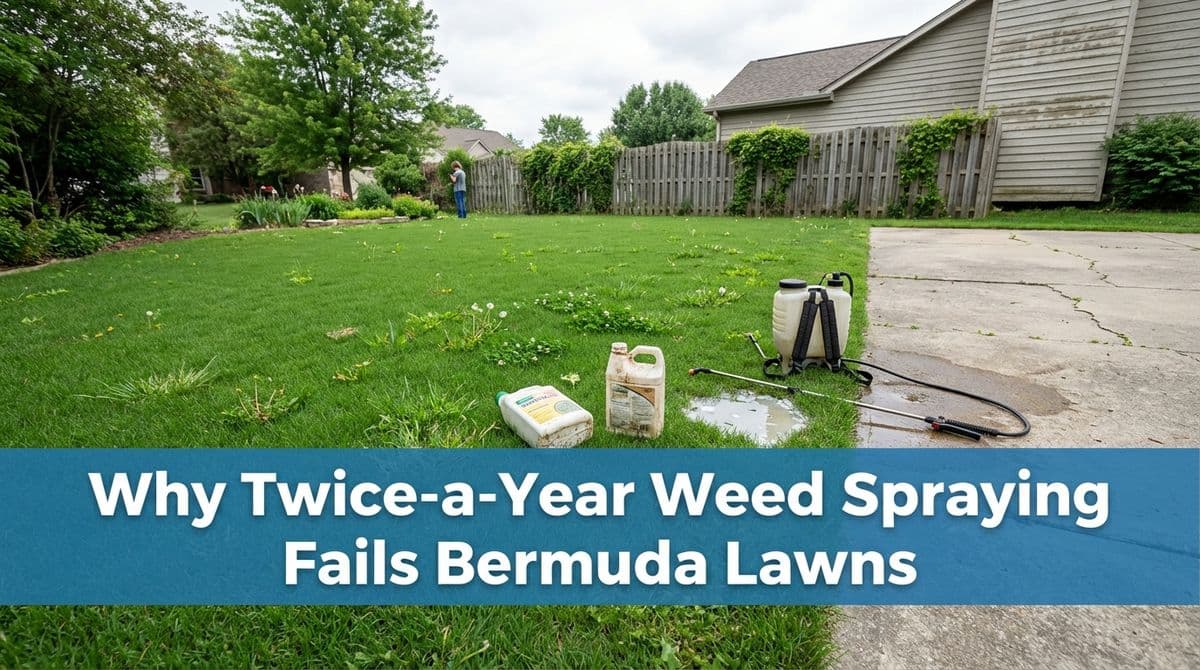
Why Twice-a-Year Weed Spraying Fails in Bermuda Lawns
We recently got a call from a homeowner — let’s call him Rick — who was frustrated with the weeds in his Bermuda lawn. He told us he’d been paying another company to spray his yard twice a year for the last five years, but the weeds were still there all year long. Same lawn, same weeds, same disappointment.
By the time he called us, he’d already stopped that service because, as he put it, “I was having it sprayed twice a year and the weeds were there all year round.” That experience is more common than you might think, especially with Bermuda lawns here in our region.
Rick’s situation is exactly why we don’t offer one-time or twice-a-year weed spraying. Instead, we run a seven-round, year-long program that’s designed around how weeds actually grow in Bermuda grass — and why they keep coming back if you don’t stay ahead of them.
How Weeds Work in a Bermuda Lawn
Bermuda is a tough, sun-loving grass, but it has plenty of competition. In our area, we see:
- Winter annuals like henbit and chickweed that germinate in the fall and show up early spring.
- Summer annuals like crabgrass that love the heat and pop up mid to late spring.
- Perennial weeds like Dallas grass, nutsedge, and goosegrass that can come back year after year if not treated correctly.
The key detail: these weeds don’t all show up at the same time. They germinate in different seasons, under different conditions. A quick spray in spring and another in summer simply can’t cover all the different germination windows.
That’s why Rick was seeing the “same weeds” year after year. The timing and products weren’t matching what was actually happening in his Bermuda lawn.
Why Twice-a-Year Spraying Isn’t Enough
Most twice-a-year programs are really just broad, one-size-fits-all treatments. They usually rely on a general herbicide at two points in the year and hope for the best. With Bermuda lawns, that approach has a few major problems:
- Missed seasons: If you only spray twice, you’ll miss either the early fall/winter weeds or the late-summer flush, sometimes both.
- No follow-through: Even effective sprays don’t stop every single weed. Without follow-up visits, survivors go to seed and start the cycle over.
- Perennials need targeted spot treatments: Weeds like nutsedge and Dallas grass almost never disappear with a single blanket spray.
So even if the product is decent, the schedule just doesn’t line up with how weeds behave. A Bermuda lawn needs a program, not a one-time “weed killer” visit.
What Our Seven-Round Bermuda Lawn Program Looks Like
When Rick called, we explained that we treat Bermuda lawns seven times throughout the year. Each visit is there for a reason, and we change products as the seasons change.
Here’s a simplified version of how our program works:
- Multiple pre-emergent rounds: We do three rounds of pre- and post-emergent products at different times of year to target weeds before and as they sprout. No single product controls everything.
- Fertilizer plus weed control: During fertilizer visits, we’re still out there spot treating problem weeds, especially stubborn perennials.
- Season-specific spot treatments: In the spring, we often see nutsedge if we’ve had a lot of rain, so we’re ready to treat that. During the heat of the growing season, we look for Dallas grass and goosegrass and spot spray those as needed.
The goal is simple: keep weeds from ever getting comfortable in your Bermuda lawn by staying a step ahead all year long.
How We Evaluate Your Bermuda Lawn Before We Start
Before we recommend a program, we don’t just guess at your lawn size or throw out a generic quote. When Rick called, we asked about:
- What type of grass he had (his was all Bermuda).
- Whether the lawn had been treated before (his had been treated twice a year for five years).
- How much of the property was actual turf versus wooded or natural areas.
From there, we measure only the turf areas that will be treated. That way, you’re not paying for wooded spaces that don’t need weed control. We use this measurement to tailor the program and pricing to your actual lawn, not just a rough lot size.
Common Misconceptions About Weed Control in Bermuda Lawns
“If the weeds don’t die after one visit, the treatment didn’t work.”
We hear this a lot. In reality, some weeds are easy to knock down, while others — especially perennials — may take multiple targeted applications. Also, pre-emergents are working invisibly in the soil to stop new weeds from germinating, so you might not see dramatic change overnight, but they are doing their job.
“I only need to treat when I see weeds.”
By the time you see weeds, they’ve already germinated, grown, and often started to spread. A good Bermuda program is proactive, not reactive. That’s why we plan treatments ahead of each season, not just when things look bad.
“Fertilizer alone will crowd out the weeds.”
Healthy Bermuda can compete with some weeds, but fertilizer won’t control established invaders like nutsedge or Dallas grass. You need the right combination of nutrition and selective herbicides to get the best results.
FAQ: What Homeowners Usually Ask Us
How long until I see results?
Most homeowners start noticing improvement within the first 1–2 visits — fewer new weeds and existing ones starting to thin out. The real payoff, though, comes over the course of the full year, as pre-emergent treatments break the cycle and the Bermuda thickens up with proper fertilization.
Is it safe for pets and kids?
Used as directed, our lawn care products are safe for typical residential use. We always recommend keeping pets and kids off the lawn until sprays have dried completely, which usually takes a few hours. After that, normal use of the yard is fine.
Can you just do one visit to “clean it up”?
We understand the temptation, but with Bermuda lawns — especially if you’re already fighting years of weed pressure like Rick was — a one-time spray is rarely money well spent. The weeds you see today are the result of months or years of seed and root build-up. A structured, year-round plan is what actually changes that pattern.
Building a Weed-Resistant Bermuda Lawn for the Long Term
When Rick first called, he just wanted someone to “spray to kill the weeds.” After we walked him through how our seven-round program works — different products, different seasons, and ongoing spot treatments — he understood why twice-a-year spraying had failed him.
If your Bermuda lawn feels like a constant battle, it’s probably not that your grass can’t thrive — it’s that the approach hasn’t matched the way weeds really behave. A year-round lawn program that combines pre-emergent, post-emergent, and proper fertilization gives your Bermuda the edge it needs, season after season.
We’re always happy to take a look at your lawn, measure the actual turf, and talk you through what a full-year plan would look like for your property.